

The Role of Drainage Planning in Successful Hardscape Projects
Preventing Water Damage with Proper Grading and Runoff Management
Drainage planning is the foundation every hardscape project depends on, and it’s the element most likely to be underestimated until something fails. Improper grading causes water to pool on patio surfaces and work into the aggregate base below the pavers. Freeze-thaw cycles then expand that trapped moisture, heaving the surface and opening joints. By the time shifting, pooling, or soft spots become visible, the drainage problem has typically been building since day one of the installation. Getting grading, subsurface systems, and structural water management right from the start is what protects the investment for decades.
Most homeowners never think about drainage until something goes wrong. Water pooling in the corner of the patio after every rain. Pavers starting to shift two years in. A section of walkway that feels soft underfoot in the spring. By the time those things show up, the drainage problem has usually been building since the day the project was installed.
This is the part of hardscape construction that doesn’t show up in the finished photos. Nobody’s posting before and after shots of their subsurface drainage system. But it is quietly the difference between a patio that holds up for decades and one that starts failing on a schedule.
Proper grading is where it starts. Before anything gets built, the natural slope of the property gets evaluated and every surface gets designed to work with it. Patio pavers that aren’t graded correctly don’t just look bad when water pools on them. They fail at the base level because water is sitting where it shouldn’t be, working its way into the aggregate beneath the surface. Pavers for patio areas have to be pitched to move water away from the home, not toward it.
The same thinking applies everywhere else on the property. Pavers for walkways need a calculated pitch that moves water to designated drainage zones. Driveway pavers that pool water in the center aren’t just inconvenient. They’re shortening the life of the surface and everything under it. A backyard retaining wall or concrete retaining wall doesn’t just manage elevation changes. When it’s engineered properly it also channels water safely across the landscape rather than letting it collect at transition points.
| Drainage Issue | What Causes It | Consequence | Solution |
|---|---|---|---|
| Surface pooling | Inadequate or reversed slope | Base erosion, paver staining | Regrade surface, add channel drain |
| Paver shifting | Water trapped in aggregate base | Unlevel surface, safety hazard | Subsurface drainage, proper pitch |
| Joint opening | Freeze-thaw expansion of trapped moisture | Structural instability | Improve drainage, resand joints |
| Wall undermining | Poor drainage behind retaining wall | Wall failure over time | Drain tile, crushed stone backfill |
| Foundation runoff | Slope directing water toward home | Foundation damage | Regrade entire surface pitch |
Why Drainage Is Critical in New Jersey’s Changing Climate
New Jersey’s climate puts hardscape through a reliable annual stress cycle: heavy spring rains saturate the ground, summer storms deliver concentrated runoff, and winter freeze-thaw activity expands any trapped moisture against whatever’s above it. Dense materials like bluestone pavers and brick patio pavers are built to handle all of that. But they’re only as tough as the foundation they’re sitting on. When drainage is inadequate, water infiltrates the base layer, freezes, expands, and heaves the surface. Come spring, the patio that looked level in November has raised spots, sunken sections, and opened joints. The pavers themselves are often fine. The installation underneath them isn’t.
Patio stone pavers and concrete driveway pavers need excess moisture to move freely through properly prepared aggregate layers below the surface. That’s what protects the subgrade. Without it, water pressure builds, the base weakens, and visible settlement follows. It’s not a question of if. It’s a question of when.
The areas around structural features deserve specific attention. An outdoor fireplace or backyard fire pit needs to stay dry and stable, not just for appearance but for safety. Water that sits around a masonry fire feature long enough works into the material and accelerates deterioration. Managing moisture in those zones proactively means the feature performs correctly and stays looking the way it should for years.
Design Strategies That Protect Patios, Walkways, and Foundations
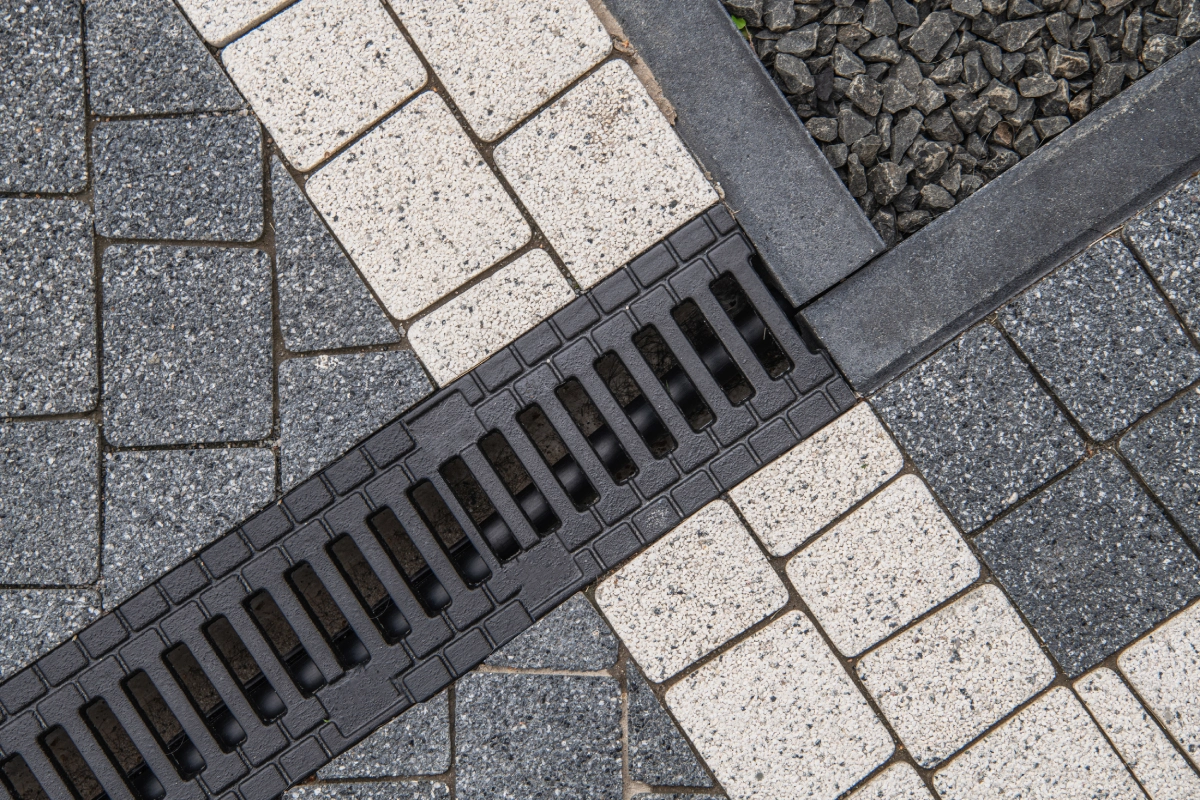
Effective drainage design combines surface grading with subsurface engineering. Perforated piping, drainage stone layers, and correctly pitched aggregate bases redirect water before it ever becomes a surface problem. Channel drains and downspout extensions manage concentrated runoff at specific points, including the corners where overhead pergola structures concentrate rainfall. The areas around outdoor kitchens need their own drainage consideration because plumbing, appliances, and cabinetry all have to stay protected from excess moisture. Drainage planning done right is invisible when the project is finished, and that invisibility is exactly what it’s supposed to achieve.
Outdoor cooking areas need their own drainage consideration. The area around outdoor patio kitchens deals with plumbing, appliances, and cabinetry that all need protection from excess moisture. Downspout extensions, channel drains, and smart surface grading around high-traffic zones keep water moving rather than sitting.
Overhead structures change the equation in ways that catch people off guard. An aluminum pergola doesn’t just provide shade. It also concentrates rainwater runoff at specific edges and corners rather than letting it disperse naturally across the patio. That concentrated flow has to be planned for in the grading. If it isn’t, you end up with a drainage problem directly under the structure that gets a full concentrated dose of runoff every time it rains.
Drainage planning isn’t a detail of hardscape construction. It’s the foundation the whole project sits on, literally and functionally. Align the grading, the structural support, and the water management systems from the very beginning of the project and the patio, the walkways, and the foundation all stay protected. Treat drainage as an afterthought and the rest of the work, no matter how well executed on the surface, is working against itself from day one.
Frequently Asked Questions
How is proper slope determined for a patio or walkway?
It gets calculated based on surface area, where the water needs to go, and how close the surface is to the home. The slope needs to be consistent enough to drain effectively but not so noticeable that the surface feels tilted when you’re standing on it. That balance is something experienced installers work out during the design phase, not during installation.
What happens if drainage is ignored during installation?
Standing water shows up first. Then surface erosion. Then the base starts to compromise and the pavers start shifting or settling. Over time those small problems compound into repairs that cost significantly more than the drainage work that would have prevented them. It’s one of those situations where the shortcut ends up costing more in the long run.
Are drainage systems visible after installation?
Most of the system is completely hidden beneath the surface. Channel drains and grates may have visible components but they’re designed to blend with the surrounding hardscape. Done well, guests don’t notice them. They just notice that the patio drains properly.
Can drainage solutions be added to an existing patio?
Sometimes yes. Channel drains can be retrofitted into certain installations and regrading is possible in some situations. A site evaluation determines what’s actually feasible and what the most effective corrective approach would be. It’s not always a simple fix but it’s often better than starting over.
Why is professional planning important for water management?
Because soil behavior, climate impact, and the structural engineering of how water moves through and around a hardscape aren’t things you figure out by instinct. Experienced installers have seen what happens when drainage gets underestimated, and they design to prevent it. That expertise is what you’re paying for when drainage is planned professionally from the start.